The Association of Co-Response Clinicians (ACRC)
Built by Clinicians. Guided by Ethics. Focused on Trust.

Find us on:
Facebook- The Association of Co-Response Clinicians
Instagram- @coresponseclinicians
LinkedIn- Association of Co-Response Clinicians
TikTok- @acrc67
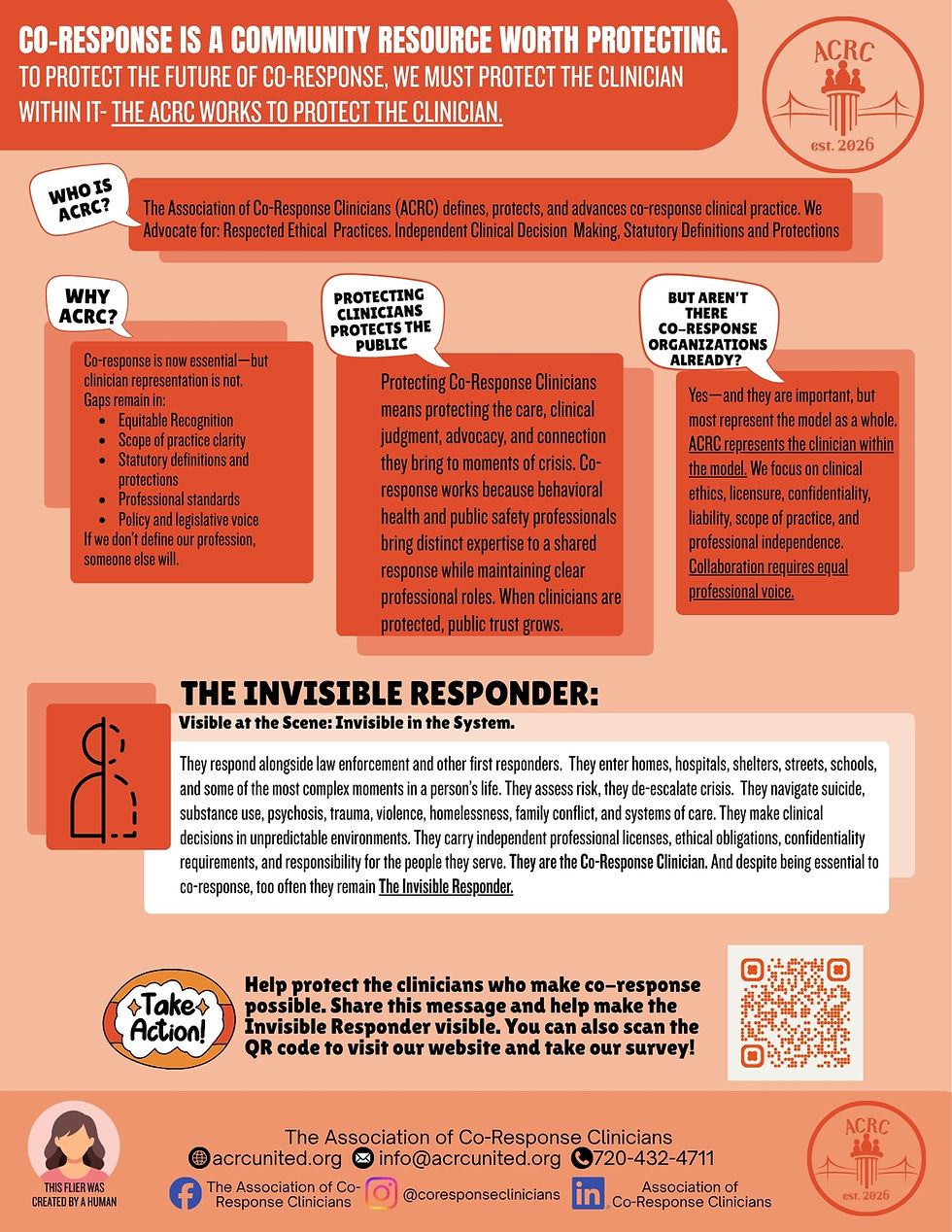
Protecting Clinicians Protects the Public.
The clinician brings something distinct to the scene: behavioral health expertise, clinical judgment, advocacy, confidentiality, and connection during moments of crisis.
Those responsibilities are not barriers to collaboration. They are part of what makes co-response work.
When clinicians are able to practice within clearly defined professional and ethical boundaries, first responder partnerships are stronger. When the public can trust the independence and integrity of the behavioral health professional responding to their crisis, co-response is stronger.
Protecting the clinician protects the integrity of the model.
And protecting the integrity of the model protects the community resource we have worked so hard to build.
The clinicians doing this work deserve a voice in the standards, policies, protections, and decisions shaping their profession.
Why the Invisible Responder Campaign?
Co-response has become an essential community resource. Yet as the model has expanded, recognition and protections for the clinicians within it have not always kept pace.
The Invisible Responder Campaign is an advocacy initiative of the Association of Co-Response Clinicians (ACRC) created to bring the clinician into the conversations shaping the future of co-response.
Co-response brings behavioral health and public safety professionals together at the same scene—but collaboration does not erase the distinction between their professional roles.
The clinician remains a clinician.
Clinical responsibility does not disappear in the field. Neither do ethical obligations, confidentiality, licensure requirements, scope of practice, liability, or the responsibility to exercise independent clinical judgment.
Protecting those distinctions is not about creating distance between clinicians and their first responder partners. It is about creating stronger partnerships built on clear roles, mutual respect, and equal professional voice.
Protect clinical independence. Protect public trust.
There is no co-response without the clinician- yet these voices are often under-represented in discussions related to policy and procedures related to the Co-Response Model of Service.
Every day, co-response clinicians work alongside law enforcement and other first responders in homes, hospitals, shelters, streets, schools, and some of the most complex moments in a person’s life.
They assess risk. They de-escalate crisis. They navigate suicide, substance use, psychosis, trauma, violence, homelessness, family conflict, and complex systems of care. They make independent clinical decisions in unpredictable environments while carrying professional licenses, ethical obligations, confidentiality requirements, and responsibility for the people they serve.
They are present at the crisis.
But when decisions are made about the policies, protections, standards, legislation, and systems that shape co-response, the clinician is too often missing from the conversation.
This is the Invisible Responder.
.jpg)
The clinician is not an accessory to co-response.
The Invisible Responder
Welcome to the Invisible Responder Campaign

VISIBLE AT THE SCENE.
INVISIBLE AT THE TABLE
There Is No “Co” Without Us.
Co-response depends on partnership.
WHO SPEAKS FOR THE CLINICIAN?
Law enforcement has professional associations.
Firefighters have professional associations.
EMS professionals have professional associations.
Behavioral health has professional organizations.
Even Co-Responders have advocacy organizations- but none that focus on the clinician.
But co-response clinical practice exists at the intersection of these systems—and that intersection creates professional challenges that traditional organizations were not necessarily designed to address.
Co-Response Clinicians need a professional home dedicated specifically to the realities of this work.
That is why ACRC exists.
.jpg)

THERE IS NO “CO” WITHOUT US.
Co-response depends on partnership—and partnership means equal voice, mutual respect, and shared representation.
Co-Response Clinicians bring an independent clinical role to the scene. Protecting that role doesn’t weaken the partnership. It strengthens it.
The ACRC’s Invisible Responder Campaign is working to make sure clinicians are seen, heard, and represented in the systems shaping co-response.
Join the movement- Visit our website for more information - acrcunited.org
#InvisibleResponder
#ACRCunited #CoResponse
#CoResponseClinicians
#CrisisResponse
#mentalhealthmatters
#BehavioralHealth
Join the movement by subscribing for updates from the ACRC.

Please follow us on social media!
Like and share our post to help spread the word!
The ACRC is here to protect the future of Co-Response and Public Trust!